
PEN 44.90
A three-layer spectral separator that splits audio into tone, transients, and air, with independent level control for each.
LAYER SEPARATOR
A three-layer spectral separator that splits audio into tone, transients, and air, with independent level control for each.
LAYER SEPARATOR
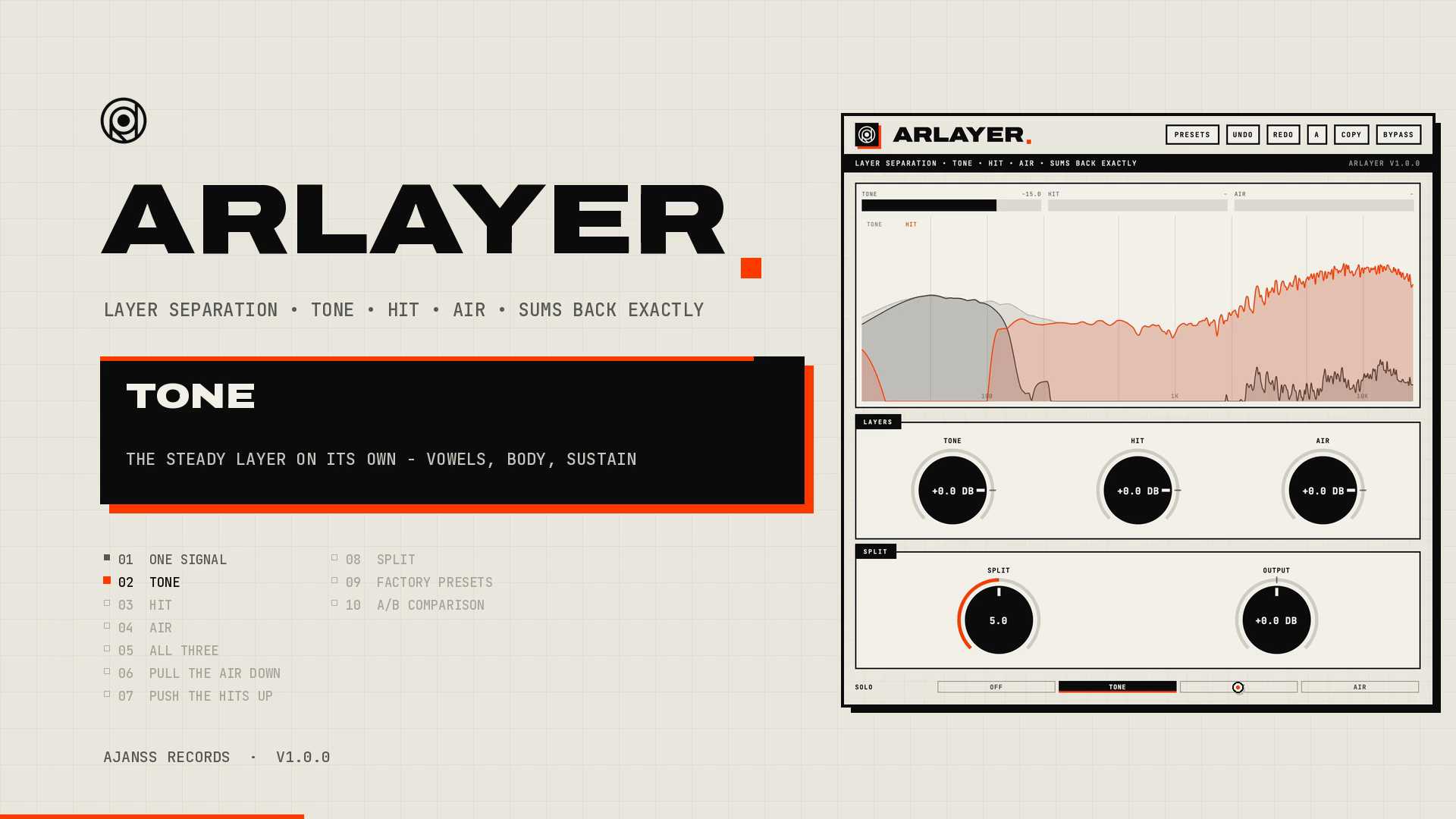
ARLAYER separates audio into three complementary layers, each with its own fader. TONE captures steady material such as body, vowels, and sustain. HIT isolates transient content such as picks, sticks, and consonants. AIR contains the remaining detail, including breath, room, cymbal wash, and anything not clearly assigned to the other two layers. Rather than estimating AIR separately, ARLAYER defines it as the input minus TONE and HIT. This keeps ambiguous material accessible instead of hiding separation errors behind the processing. SPLIT controls how confidently frequencies must belong to TONE or HIT before they are assigned, with uncertain content collected in AIR as the setting increases. At unity, all three layers recombine to reproduce the original input bit for bit. Each layer can also be soloed independently for detailed editing and monitoring. The separation uses a fixed 4096-sample latency that remains identical at every SPLIT setting.
Not enough reviews yet