How to find the key of a song by ear, from chords or with software
To find the key of a song, find its home note, the note the music comes to rest on, then decide whether the scale built on that note is major or minor. The chords, the key signature or a key finder confirm the answer.
This guide covers finding the home note by ear and telling major from minor. It then checks the answer against the chords and the key signature, settles a major key against its relative minor, and shows the free browser tools that confirm the result.
Courses and tools for hearing keys


What the key of a song is
A key is a home note, called the tonic, plus a scale built on that note, either major or minor. In A minor, the melody and chords keep returning to A and draw most of their notes from the A minor scale. Twelve possible home notes and two scale types give 24 keys.
The key tells you which notes and chords will fit when you play along, where a guitarist puts a capo, which notes a pitch-correction plugin should allow, and which loops will sit with the track. Finding it means settling where home is, then whether the scale is major or minor, then whether the chords agree.
What you need
- The song, on repeat. You will listen to the ending of the chorus many times, so a way to loop it helps.
- Something that plays notes. A guitar, a keyboard, a keyboard app on your phone, or the free Tone Generator in your browser.
- Optional extras. A chord chart or sheet music speeds things up, and an audio file of the song lets a key finder check your answer.
Step 1: find the home note by ear
The tonic is the note where the music sounds finished. To hear it, play the end of a chorus or the very last bar of the song and stop the playback right after the final chord.
- Hum the note that feels like the end. Sing it quietly and hold it. If the song stopped in the right place, that note will feel settled.
- Sing it over the rest of the song. The tonic fits under long stretches of the music. A wrong guess sounds unresolved, especially at the end of a phrase.
- Find the note on an instrument. Play single notes until one matches your hum. On a guitar, try notes on the low E string; on a keyboard, work up from any C.
Without an instrument, use the Tone Generator. Type a frequency in hertz, such as 220 Hz for the A below middle C or 261.63 Hz for middle C, and slide the pitch while it plays until it matches your hum. Then let it drone under the song. Over the right note, the ending sounds resolved; over a wrong one, the final chord clashes with the drone.
Step 2: decide whether the key is major or minor
With the tonic found, play the major scale and the natural minor scale from it while the song runs. The one that follows the melody without sour notes gives the answer.
The quickest test is the third note of the scale. Play the tonic, then the note four semitones above it (a major third) and the note three semitones above it (a minor third). Whichever one the melody leans on tells you the scale. In C, that is E for C major or E♭ for C minor.
You can also test the tonic chord. Strum or play the major chord on the tonic, then the minor one, at the end of the chorus. One will match the recording and the other will clash. If the two still sound alike to you, Ear Training Explained - Triads drills major, minor, diminished and augmented chords with listening tests.
Mood is a weaker clue. Major keys tend to sound bright and minor keys darker, but tempo, sound and lyrics change the mood as much as the key does.
Step 3: check the answer against the chords
Each major key has seven chords built from its own notes. Their types always come in the same order. Counting up from the tonic, they are major, minor, minor, major, major, minor and diminished. Musicians number them with Roman numerals, upper case for major chords and lower case for minor ones.
| Degree | Chord type | In C major | In G major | In F major |
|---|---|---|---|---|
| I | Major | C | G | F |
| ii | Minor | Dm | Am | Gm |
| iii | Minor | Em | Bm | Am |
| IV | Major | F | C | B♭ |
| V | Major | G | D | C |
| vi | Minor | Am | Em | Dm |
| vii° | Diminished | B° | F♯° | E° |
Write down the chords of the song, or read them from a chart, and find the column that contains all of them. Then check the last chord. The chord a song ends on is a stronger clue than the one it starts on, since a song can open on the IV or the vi chord and only reach home later.
One chord from outside the set does not change the key. A rock song in C major can use a B♭ chord, borrowed from C minor, and a blues in A uses A7, D7 and E7 while staying in A. Look for the chord the song keeps resolving to.
Major key or its relative minor
Every major key shares all seven notes and its key signature with one minor key, its relative minor. The relative minor starts on the sixth note of the major scale, three semitones below the major tonic. C major and A minor both use only the white keys of a piano; G major and E minor share one sharp, F♯.
| Major key | Relative minor | Key signature |
|---|---|---|
| C major | A minor | No sharps or flats |
| G major | E minor | 1 sharp |
| D major | B minor | 2 sharps |
| A major | F♯ minor | 3 sharps |
| E major | C♯ minor | 4 sharps |
| B major | G♯ minor | 5 sharps |
| F♯ major | D♯ minor | 6 sharps |
| D♭ major | B♭ minor | 5 flats |
| A♭ major | F minor | 4 flats |
| E♭ major | C minor | 3 flats |
| B♭ major | G minor | 2 flats |
| F major | D minor | 1 flat |
The chord check in step 3 always leaves these two candidates, because they use the same chords. A progression of Am, F, C and G fits both C major and A minor. Three clues decide it:
- Where it comes to rest. A chorus that ends on C points to C major. One that keeps landing on Am points to A minor.
- A major V chord. In a minor key, the chord on the fifth note is frequently played as a major chord. In A minor, that is E or E7 in place of Em, and it contains G♯, a note C major does not have. An E chord between Am chords is a strong sign of A minor.
- The bass on the last beat. The lowest note under the final chord is usually the tonic.
Hear it on a piano. Both clips play Am, F, C and G. The first ends on C, and that last chord sounds like home: C major.
Ending on C
The second adds an E major chord, with its G♯, and ends on A minor. Most of the chords are the same, but now A minor is home.
Ending on A minor
The parallel minor is a different relationship. It shares the home note and changes the notes. C major and C minor are parallel keys, and C minor has three flats.
How to read the key from sheet music
On a score, the key signature at the start of each staff narrows the key to one major key and its relative minor.
- Sharps. The key is one semitone above the last sharp. One sharp (F♯) means G major; two (F♯ and C♯) means D major.
- Flats. The second-to-last flat names the key. B♭ and E♭ mean B♭ major; one flat on its own means F major.
- Then choose major or minor. Look at the last chord and the last bass note. A sharpened note that keeps appearing, such as G♯ in a piece with no key signature, points to the relative minor.
A key signature describes the piece as written. A passage can change key with accidentals and leave the signature alone, so check the chords there too. To move a score to a key that suits a voice or an instrument, transpose it in MuseScore Studio, which moves the notes, the key signature and the chord symbols together.
How to find the key of a song with software
The free Key Finder reads an MP3, WAV, FLAC, M4A or OGG file in your browser, and the file is never uploaded. The result names the key, its relative major or minor, a Camelot code, a confidence level, the song’s tempo and a list of keys that mix with it.
Here is its result for the first piano clip above, the progression that ends on C.
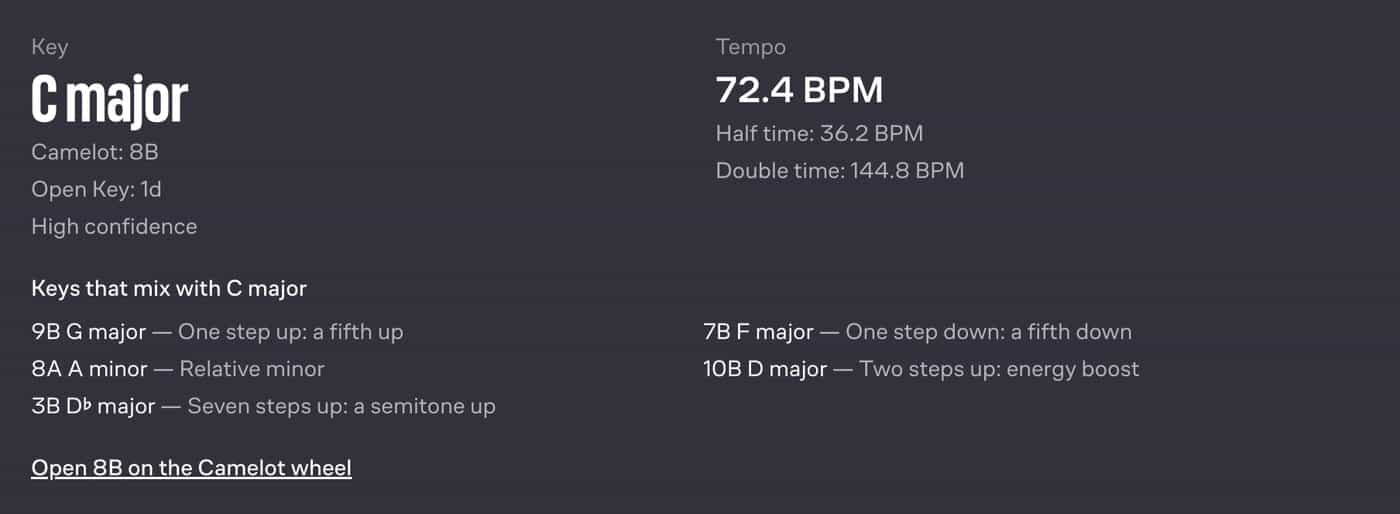
Use the confidence level as a prompt for the methods above. A high level means one key clearly leads. A low one often means the song sits between two related keys or changes key, so hum the home note and settle it by ear. The finder needs a file on your device, so for a song you can only stream, use the ear method.
The Camelot code is the DJ way of writing a key, a number from 1 to 12 plus A for minor or B for major. A minor is 8A and C major is 8B, so relative keys share a number. The Camelot Wheel shows all 24 codes. Choosing the next track by key is a separate skill, covered in harmonic mixing.
When the key is hard to pin down
- The song changes key. A last chorus that jumps up a semitone or a whole step is a key change. Name the key of the verses and earlier choruses, and note the change if you are playing along.
- The song uses a mode. Dorian and Mixolydian use the notes of a major key around a different home note. A song that rests on D and uses only the white keys is in D Dorian; a key finder will report the nearest major or minor key.
- The recording is off standard tuning. A record tuned away from A = 440 Hz, or transferred at a slightly wrong speed, falls between two keys. Tune your instrument to the record before you match notes.
- The edit is sped up or slowed down. Speed changes pitch unless the edit used time-stretching, so a nightcore version sits in a different key from the original.
What to do with the key
Pitch correction needs the key, because a tuner pulls each note toward the notes it is allowed to use. How to autotune in Audacity shows how to set the key on a free tuner. For the session, ARTUNE STUDIO in the Pitch Tools bundle by Ajanss Records takes a key and a scale.
If you play along on guitar or bass, ARTUNER is a free tuner plugin with a reference pitch you can set from 415 to 465 Hz, which helps with a record that is off standard tuning. For a beat or a topline, loops on MuseHub are tagged with a key, and how to write a topline with loops and beats shows how to pick ones that fit.
Finding the key gets faster with practice. Harmonic Ear Training, presented by the assistant chair of the Ear Training Department at Berklee College of Music, trains you to recognize chord progressions by ear.
FAQ
Next steps
To hear keys faster next time, browse the music courses on MuseHub, where the ear-training and theory courses sit together. Get MuseScore Studio, the tuners and the courses in one place — download MuseHub free.