Note frequency chart: the frequency of every musical note
A note frequency chart lists the pitch of every musical note in hertz (Hz), the number of times the sound wave repeats each second. With A4 tuned to 440 Hz, middle C (C4) is 261.63 Hz, and each note is the one below it multiplied by the twelfth root of two, about 1.0595, so every octave doubles the frequency.
Below is the full chart from C0 to B8 to two decimal places, with the formula behind it and the piano key and MIDI (Musical Instrument Digital Interface) note numbers. After it come the octave labels that digital audio workstations (DAWs) disagree on and the lowest notes of common instruments. The last part shows how producers use these numbers to tune a bass, place an equalizer (EQ) cut and test a subwoofer.
Tuning and test-signal plugins on MuseHub
Frequencies of musical notes from C0 to B8
Each row is a note name and each column an octave. Values are in hertz, rounded to two decimal places, for twelve-tone equal temperament with A4 at 440 Hz.
| Note | Octave 0 | Octave 1 | Octave 2 | Octave 3 | Octave 4 | Octave 5 | Octave 6 | Octave 7 | Octave 8 |
|---|---|---|---|---|---|---|---|---|---|
| C | 16.35 | 32.70 | 65.41 | 130.81 | 261.63 | 523.25 | 1,046.50 | 2,093.00 | 4,186.01 |
| C♯/D♭ | 17.32 | 34.65 | 69.30 | 138.59 | 277.18 | 554.37 | 1,108.73 | 2,217.46 | 4,434.92 |
| D | 18.35 | 36.71 | 73.42 | 146.83 | 293.66 | 587.33 | 1,174.66 | 2,349.32 | 4,698.64 |
| D♯/E♭ | 19.45 | 38.89 | 77.78 | 155.56 | 311.13 | 622.25 | 1,244.51 | 2,489.02 | 4,978.03 |
| E | 20.60 | 41.20 | 82.41 | 164.81 | 329.63 | 659.26 | 1,318.51 | 2,637.02 | 5,274.04 |
| F | 21.83 | 43.65 | 87.31 | 174.61 | 349.23 | 698.46 | 1,396.91 | 2,793.83 | 5,587.65 |
| F♯/G♭ | 23.12 | 46.25 | 92.50 | 185.00 | 369.99 | 739.99 | 1,479.98 | 2,959.96 | 5,919.91 |
| G | 24.50 | 49.00 | 98.00 | 196.00 | 392.00 | 783.99 | 1,567.98 | 3,135.96 | 6,271.93 |
| G♯/A♭ | 25.96 | 51.91 | 103.83 | 207.65 | 415.30 | 830.61 | 1,661.22 | 3,322.44 | 6,644.88 |
| A | 27.50 | 55.00 | 110.00 | 220.00 | 440.00 | 880.00 | 1,760.00 | 3,520.00 | 7,040.00 |
| A♯/B♭ | 29.14 | 58.27 | 116.54 | 233.08 | 466.16 | 932.33 | 1,864.66 | 3,729.31 | 7,458.62 |
| B | 30.87 | 61.74 | 123.47 | 246.94 | 493.88 | 987.77 | 1,975.53 | 3,951.07 | 7,902.13 |
In equal temperament a sharp and the flat of the note above it are one pitch, so C♯ and D♭ share a row and a frequency.
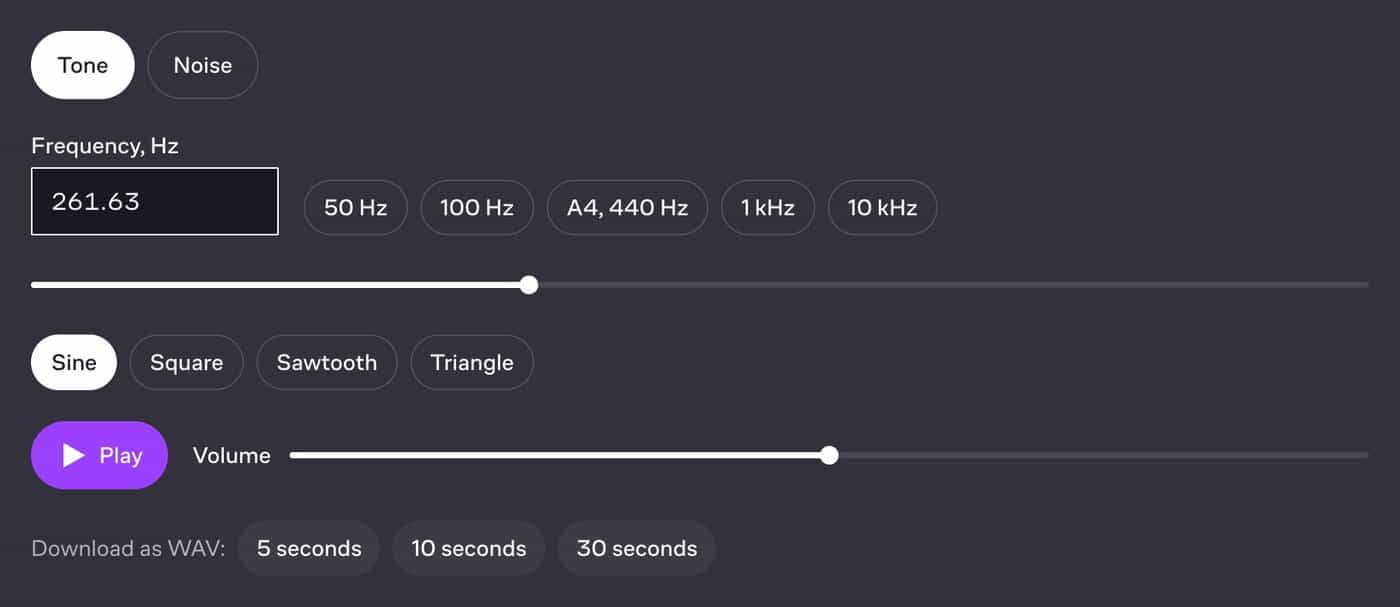
To hear a note, type its value into the free Tone Generator. Its frequency field takes two decimal places, so 261.63 plays middle C. The generator covers 20 Hz to 20 kHz, which leaves out only the four notes from C0 to D♯0. E0, at 20.60 Hz, is the lowest note it plays.
How note frequencies are calculated
Equal temperament divides the octave into 12 equal steps called semitones. The ear hears pitch as ratios, so equal steps mean equal ratios. Each semitone multiplies the frequency by the twelfth root of two, about 1.059463, and twelve of them multiply it by exactly 2. That is why A3 is 220 Hz, A4 is 440 Hz and A5 is 880 Hz.
One octave of a keyboard shows the pattern. Each key is the one before it times 1.0595, and C5 lands on exactly twice the frequency of C4.
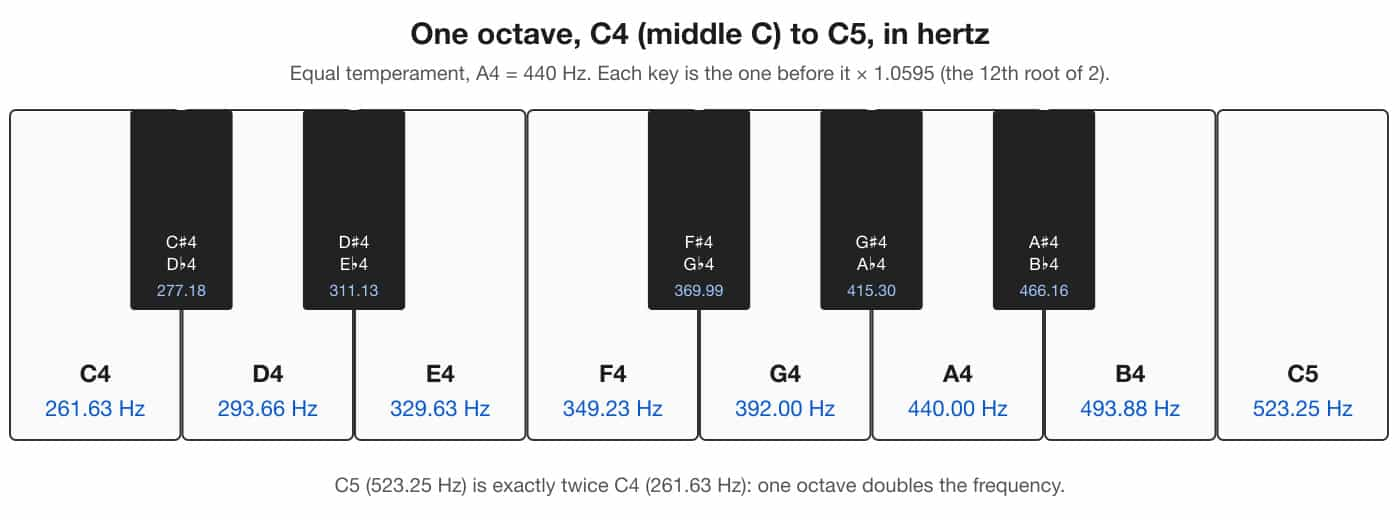
The chart comes from one formula.
f = 440 × 2^((n − 49) ÷ 12)
Here n is the piano key number. The lowest key on an 88-key piano, A0, is key 1. A4 is key 49 and the top key, C8, is key 88. Middle C is key 40, nine semitones below A4, so its frequency is 440 × 2^(−9 ÷ 12) = 261.63 Hz.
The formula keeps working past the keyboard. Key −8 gives C0 at 16.35 Hz, and key 99 gives B8 at 7,902.13 Hz. The reference comes from the international standard ISO 16, which fixes A4 at 440 Hz.
The table gives the key number, MIDI number and frequency of six landmark notes.
| Note | Piano key | MIDI note | Frequency (Hz) |
|---|---|---|---|
| A0, lowest piano key | 1 | 21 | 27.50 |
| E1, low E of a bass guitar | 8 | 28 | 41.20 |
| E2, low E of a guitar | 20 | 40 | 82.41 |
| C4, middle C | 40 | 60 | 261.63 |
| A4, tuning reference | 49 | 69 | 440.00 |
| C8, highest piano key | 88 | 108 | 4,186.01 |
Middle C, octave numbers and MIDI note numbers
The chart uses scientific pitch notation, a letter for the note and a number for the octave. The number goes up at every C, so B3 sits one semitone below C4, and A4 is the A just above middle C. Older books use Helmholtz names instead, where middle C is written c′.
MIDI is the protocol a keyboard uses to tell software which note was played, and it numbers notes from 0 to 127. Middle C is note 60 and A4 is note 69, so a note’s MIDI number is always its piano key number plus 20. What MIDI is and how it works covers the rest of the message, velocity included.
The MIDI standard fixes the numbers but not the octave names. Scientific pitch notation calls note 60 C4. Some DAWs and keyboard makers label it C3, and FL Studio labels it C5. The pitch is 261.63 Hz in all three cases, and only the label changes.
If a tutorial’s notes land an octave off in your piano roll, play middle C and see which name your software shows. The MIDI number is the reliable reference, because it is the same in every program.
Read a MIDI note number the same way as a frequency, by note and octave in scientific pitch notation. MIDI stops at 127, which is G9.
| Note | −1 | 0 | 1 | 2 | 3 | 4 | 5 | 6 | 7 | 8 | 9 |
|---|---|---|---|---|---|---|---|---|---|---|---|
| C | 0 | 12 | 24 | 36 | 48 | 60 | 72 | 84 | 96 | 108 | 120 |
| C♯/D♭ | 1 | 13 | 25 | 37 | 49 | 61 | 73 | 85 | 97 | 109 | 121 |
| D | 2 | 14 | 26 | 38 | 50 | 62 | 74 | 86 | 98 | 110 | 122 |
| D♯/E♭ | 3 | 15 | 27 | 39 | 51 | 63 | 75 | 87 | 99 | 111 | 123 |
| E | 4 | 16 | 28 | 40 | 52 | 64 | 76 | 88 | 100 | 112 | 124 |
| F | 5 | 17 | 29 | 41 | 53 | 65 | 77 | 89 | 101 | 113 | 125 |
| F♯/G♭ | 6 | 18 | 30 | 42 | 54 | 66 | 78 | 90 | 102 | 114 | 126 |
| G | 7 | 19 | 31 | 43 | 55 | 67 | 79 | 91 | 103 | 115 | 127 |
| G♯/A♭ | 8 | 20 | 32 | 44 | 56 | 68 | 80 | 92 | 104 | 116 | – |
| A | 9 | 21 | 33 | 45 | 57 | 69 | 81 | 93 | 105 | 117 | – |
| A♯/B♭ | 10 | 22 | 34 | 46 | 58 | 70 | 82 | 94 | 106 | 118 | – |
| B | 11 | 23 | 35 | 47 | 59 | 71 | 83 | 95 | 107 | 119 | – |
From a frequency back to a note
To name any frequency, run the formula backwards.
n = 12 × log2(f ÷ 440) + 49
Round n to the nearest whole number to get the piano key. The decimal left over, times 100, is the distance in cents, hundredths of a semitone, above or below that note. For the MIDI note, add 20 to the key number.
Take 100 Hz. The formula gives 23.35, so the nearest key is 23, which is G2 at 98.00 Hz, and 100 Hz sits 35 cents above it. Round numbers rarely land on a note, as these examples show.
| Frequency | Nearest note | That note’s frequency | Offset |
|---|---|---|---|
| 50 Hz | G1 | 49.00 Hz | 35 cents sharp |
| 60 Hz | B1 | 61.74 Hz | 49 cents flat, almost halfway to A♯1 |
| 80 Hz | D♯2 | 77.78 Hz | 49 cents sharp |
| 100 Hz | G2 | 98.00 Hz | 35 cents sharp |
| 1,000 Hz | B5 | 987.77 Hz | 21 cents sharp |
Lowest notes of common instruments
An instrument’s lowest note tells you where its weight sits on an EQ or a spectrum analyzer. These are the open strings and bottom keys in standard tuning.
| Instrument | Lowest note | Frequency (Hz) |
|---|---|---|
| Piano, 88 keys | A0 | 27.50 |
| Five-string bass | B0 | 30.87 |
| Four-string bass, double bass without extension | E1 | 41.20 |
| Seven-string guitar | B1 | 61.74 |
| Cello | C2 | 65.41 |
| Guitar in drop D | D2 | 73.42 |
| Guitar in standard tuning | E2 | 82.41 |
| Viola | C3 | 130.81 |
| Violin | G3 | 196.00 |
| Ukulele in standard GCEA tuning | C4 | 261.63 |
Every note also carries harmonics, quieter tones at whole-number multiples of its frequency. The low E of a guitar is 82.41 Hz. Its second harmonic is 164.81 Hz, which is E3, and its third is 247.22 Hz, just above B3. Harmonics are why you can still recognize a bass note on speakers too small to play its fundamental, the lowest frequency of the note.
At the top, no piano key plays a fundamental above C8, 4,186.01 Hz. Above that point a mix is mostly harmonics and noise, such as cymbal shimmer, breath and the hiss of an S.
Using the chart in a mix
Tune the 808 and the kick to the key
An 808, the long bass drum sound named after Roland’s TR-808 drum machine, is a pitched note, and so is a sub bass. When either sits outside the song’s key, it rubs against the bassline and the chords. Find the key with Key Finder, which reads it from an audio file in your browser, then tune the 808 to the root note.
In octave 1 the roots run from C1 at 32.70 Hz to B1 at 61.74 Hz. A song in F puts its 808 on F1, 43.65 Hz, and a song in A on A1, 55.00 Hz. A kick drum with a clear pitch can be tuned to the root the same way.
Place an EQ cut on a note
When a bass booms on one note, the build-up is at that note’s fundamental or one of its harmonics. If it booms every time the bass plays A, check 55 Hz (A1) and 110 Hz (A2) first. A narrow cut there leaves the other notes alone, where a wide cut across the low end would thin all of them.
Remove mains hum
Hum from power lines is 60 Hz in North America and 50 Hz in Europe, with harmonics at 120 and 180 Hz or 100 and 150 Hz. At A4 = 440 Hz both base frequencies fall between notes, as the table above shows. A narrow notch at the hum frequency removes little of the music around it. Audacity’s Notch filter opens at 60 Hz, and the Audacity equalizer guide shows where to find it.
Check how low your speakers go
The chart tells you which notes your speakers can play. A four-string bass bottoms out at E1, 41.20 Hz, and a five-string at B0, 30.87 Hz. The bass sweep in Speaker Test rises from 30 to 250 Hz, so the moment you start to hear it shows how low your setup reaches, and the chart names the note at that frequency.
If your subwoofer crosses over at 80 Hz, it plays mainly the notes up to D♯2, 77.78 Hz. The low E of a guitar, at 82.41 Hz, sits just above the split and goes mostly to the main speakers.
Tuning to a reference pitch
To tune by ear, play the reference note and the string together. Two close frequencies produce beats, a wobble in volume as many times per second as the difference between them. A string at 442 Hz against a 440 Hz reference wobbles twice a second. The wobble slows as you get closer and stops when the two match. In the Tone Generator, choose a sine wave as the reference, because it has no harmonics to compete with those of the string.
Here are the two references people tune to most. First A4 at 440 Hz, the orchestra’s A. Listen for a steady tone with no wobble in it; a string tuned against it is in tune when its own wobble stops.
A4, 440 Hz
Then middle C at 261.63 Hz, nine semitones lower. Play it after the A and you hear the major sixth between the two notes.
Middle C (C4), 261.63 Hz
Not every ensemble tunes to 440 Hz. Some orchestras tune A4 to 442 or 443 Hz, about 8 and 12 cents higher. Tuning to 432 Hz lowers every note by about 32 cents, a third of a semitone, so middle C becomes 256.87 Hz.
To convert the chart to another reference, multiply each value by the new A4 divided by 440. At A4 = 442 Hz, middle C is 262.81 Hz and the low E of a guitar is 82.78 Hz.
In a plugin the reference is a setting. The guide to autotuning a vocal in Audacity leaves Graillon 3’s reference A at 440 Hz and changes it only when the backing track was tuned elsewhere. On a guitar track the tuner comes first, so it hears the plain instrument, and the guitar signal chain explains the order of everything after it.
Tuning and test-tone plugins on MuseHub
The browser tools cover listening and checking. Inside a DAW, two free plugins from Ajanss Records do the same jobs on a track.

ARTUNER is a tuner for guitar, bass, ukulele and other pitched instruments, with needle and strobe displays. Its ten built-in tunings include standard guitar, drop D, DADGAD, open G, four- and five-string bass, and ukulele, and it measures against the strings of the tuning you pick. The reference pitch goes from 415 to 465 Hz, and every target string follows it. MUTE silences the output while it keeps listening, so you can tune between songs on stage.

ARGEN is a test-signal generator. It plays a sine wave, a logarithmic sweep from 20 Hz to 20 kHz, white noise, pink noise and a one-sample impulse, on both channels, on one side only, or in mid or side mode. When it is stopped, the audio on the track passes through unchanged, so it can stay in the chain.
FAQ
Next steps
For which instruments and problems sit in each frequency band, read the principles of EQ. Get ARTUNER, ARGEN and Graillon 3 free in one place — download MuseHub free.