How MOOZ is changing online music lessons and collaboration
For most musicians, learning never stops — a new scale, a vocal technique, a production trick — and every stage involves teaching and learning, sometimes as a student and sometimes as a mentor. Until recently one thing held back online music lessons and collaboration: real-time, high-fidelity audio that actually sounds right.
MOOZ is an app built to fix exactly that. This is the story of how it grew from a local practice tool into a music classroom used across borders, why the audio problem was so hard, and what the app does differently.

From pocket accompanist to global music platform

“We realized we could do more than just support practice — it could be about real-time learning across borders. We wanted vocalists to take lessons from instructors in other cities, music teachers to experiment with new ways of guiding students online, and students to learn instruments remotely — all with the same sound quality and presence as if they were in the same room.”
— Max Grinevich, CEO and founder of MOOZ
Why this was so hard
Standard video-call apps compress audio, drop frequencies and add latency. That is acceptable for a meeting and disastrous for music: the resonance, harmonics and tone that give a sound its character are exactly what gets thrown away. Browser-based tools fared no better, because a browser processes sound through several software layers, each adding delay.
The MOOZ team set itself four requirements:
- Studio-grade audio without compression artifacts.
- Tight synchronization with backing tracks, MIDI instruments and a metronome.
- Multi-camera setups to show hands, pedals and sheet music at once.
- Built-in music tools — a virtual piano and metronome — so a lesson does not need a second app.
The science of synchronization
Getting musicians to play together online as if they were in one room runs into physics and networks:
- Latency. Most video platforms introduce 100–300 ms of delay. Musicians notice 20–30 ms, and beyond that, playing in time becomes impossible.
- Jitter. Audio packets rarely arrive on a perfect schedule; small inconsistencies wreck rhythm.
- Lost or late packets. Some audio never arrives or arrives late, so platforms buffer — which adds more delay.
- Compression and buffering. To save bandwidth, audio is compressed and buffered, adding 50–150 ms and stripping tonal detail.
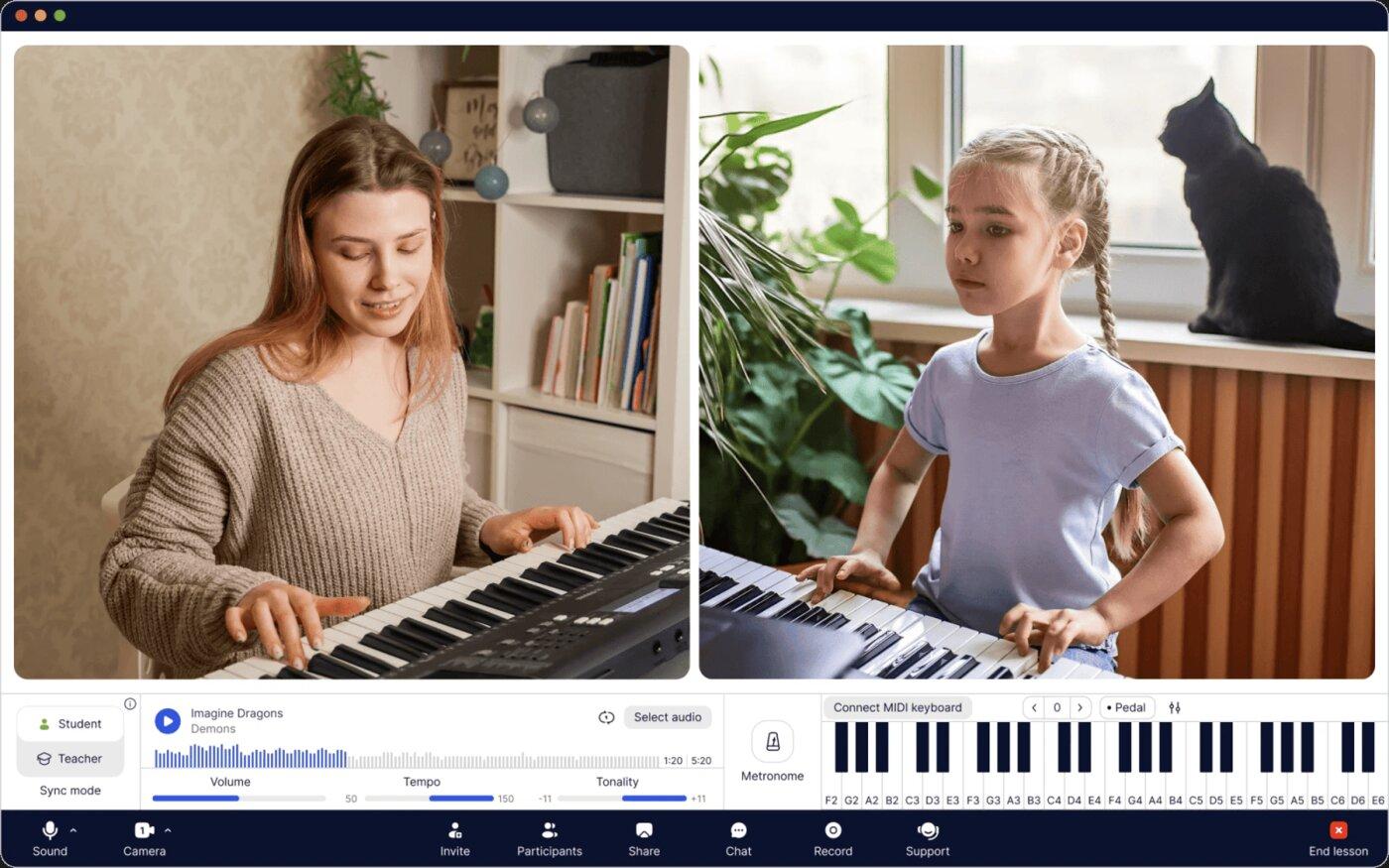
MOOZ’s answer is Sync Mode, which keeps a backing track, the virtual piano and the metronome aligned with the player on the other end. True zero latency is beyond physics; MOOZ gets remarkably close.
“We were close to giving up,” says Max. “But we knew musicians deserved better.” Years of development produced full-spectrum audio with minimal latency and stable connections.
Learning as a lifelong journey
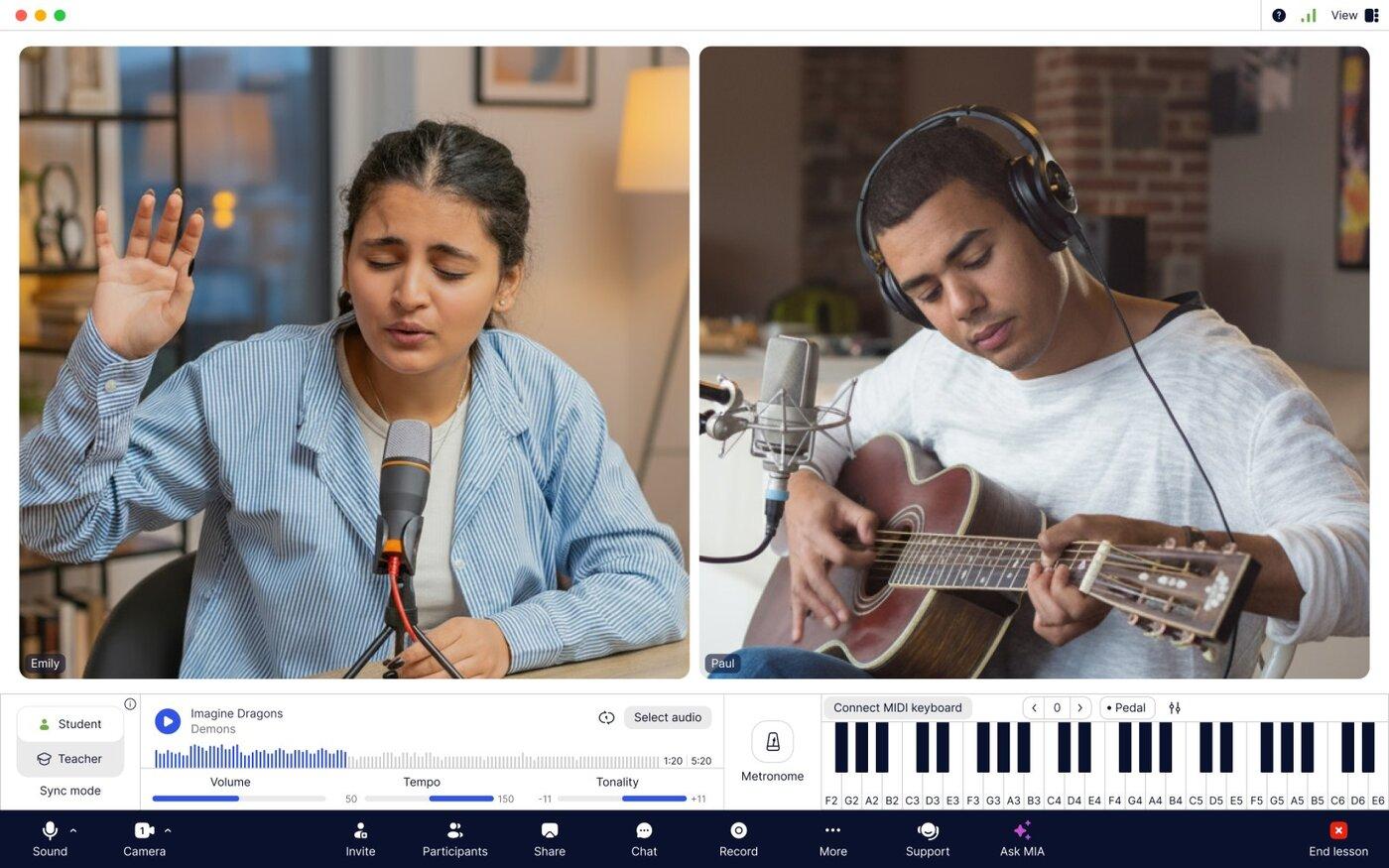
Music education is continuous: beginners learn first chords, professionals refine advanced technique, and even seasoned players take lessons to explore a new style. MOOZ removes the geography from that:
- Vocalists take masterclasses with coaches anywhere in the world.
- Guitarists rehearse with mentors on other continents.
- Educators teach many students remotely.
All in real time, without giving up sound quality. MOOZ positions itself as a music classroom built from the ground up rather than a video-call tool, for anyone invested in continuous musical growth.
Built for music, not meetings
MOOZ is musician-built. A team spread across ten countries focused on solving real problems rather than adding features, and each element is designed to reproduce in-person musical communication:
- Studio-grade audio that keeps the full frequency spectrum.
- Built-in music tools — virtual piano, metronome, an audio player with transposition, a rhythm trainer and MIDI support.
- Sync Mode that keeps backing tracks, piano and metronome aligned with the performer.
- Multi-camera support for up to five angles: instrument, pedals, sheet music.
- User-driven design shaped by thousands of teachers, students and professional musicians through testing and feedback.
Lessons from the journey
The path from a local app to a global platform taught the team four things:
- Technical challenges define innovation. The difficulty of real-time music forced new technology into existence.
- User feedback is gold. Musicians shaped every feature.
- Persistence pays off. The moments of doubt made the breakthroughs matter more.
- Music is universal. Learning, teaching and collaboration cross borders, and the technology should support that.
A platform for the future of music learning
Music has always been about connection, and distance should not change that. By solving the synchronization problem, MOOZ removes the friction that made remote lessons frustrating and gives musicians freedom, flexibility and fidelity — to learn, teach and collaborate anywhere.
At the time of writing, MOOZ reports users in more than 80 countries and over 157,000 musicians, educators and students on the platform. The app is available on MuseHub for individual learners, private teachers, music schools and organizations.
Next steps
MOOZ is one of the apps on MuseHub. If you record your own lessons or practice sessions, how to make your voice sound better and noise reduction in Audacity help the recordings sound as good as the live session. Get MOOZ and the rest in one place — download MuseHub free.