$7.19 $11.99
An algorithmic reverb with eight spaces, each its own engine, and a six-band decay contour you drag directly on the tail's own light. Decay from 0.1 to 60 seconds, a freeze that holds a tail losslessly, ducking on the unit, and HALO's pitched regeneration inside the tail. Zero latency.
Eight spaces. One curve of light.
An algorithmic reverb with eight spaces, each its own engine, and a six-band decay contour you drag directly on the tail's own light. Decay from 0.1 to 60 seconds, a freeze that holds a tail losslessly, ducking on the unit, and HALO's pitched regeneration inside the tail. Zero latency.
Eight spaces. One curve of light.
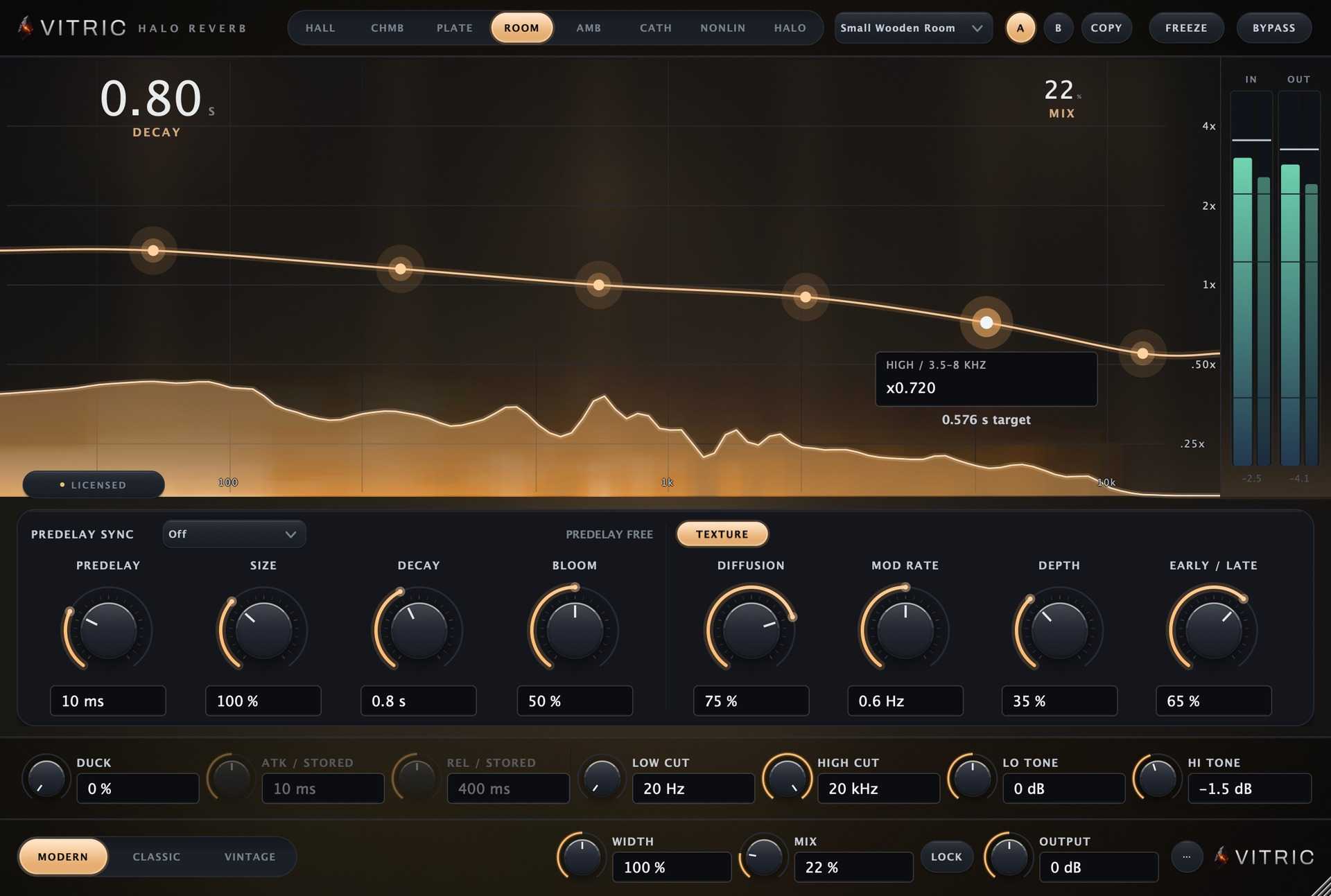
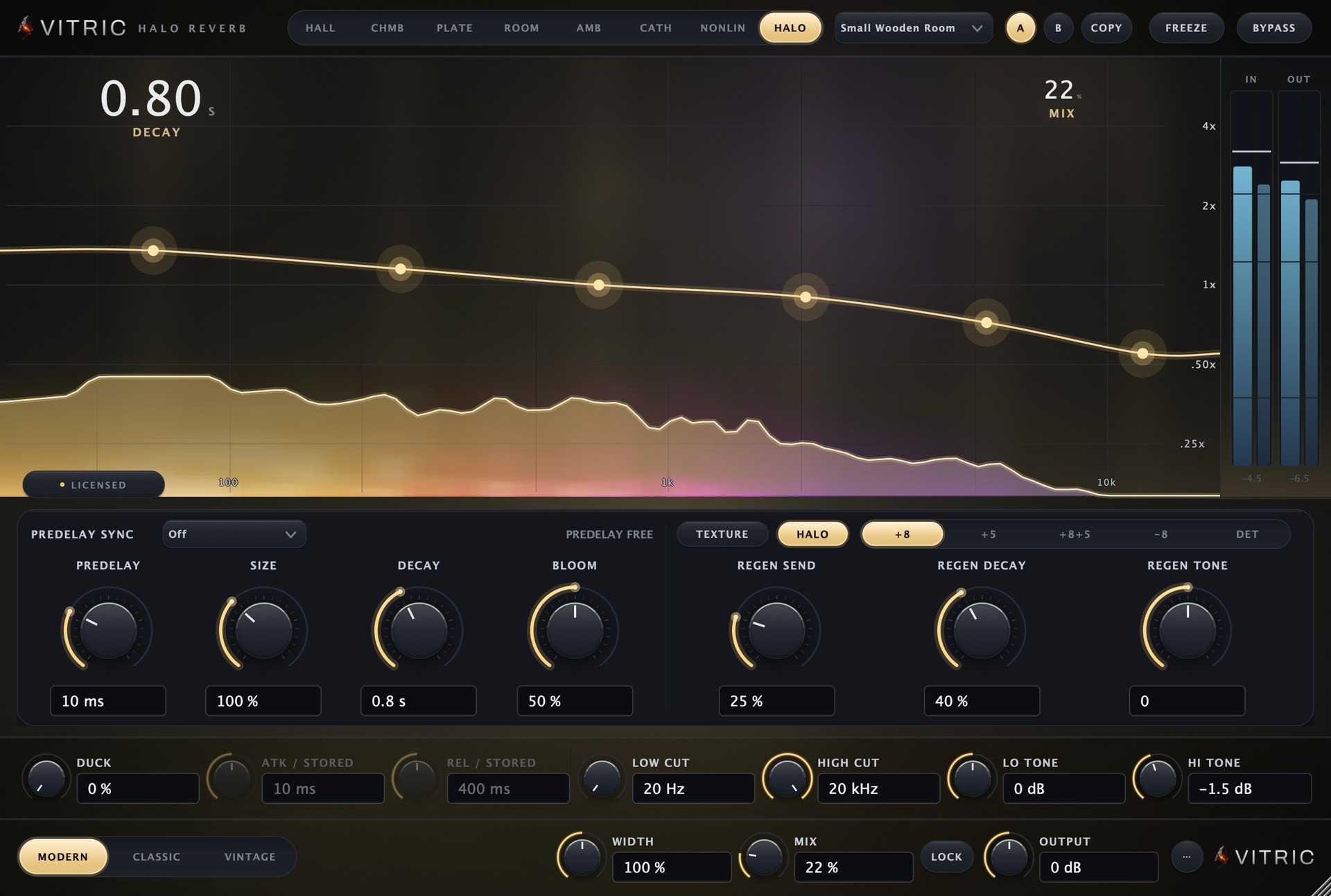
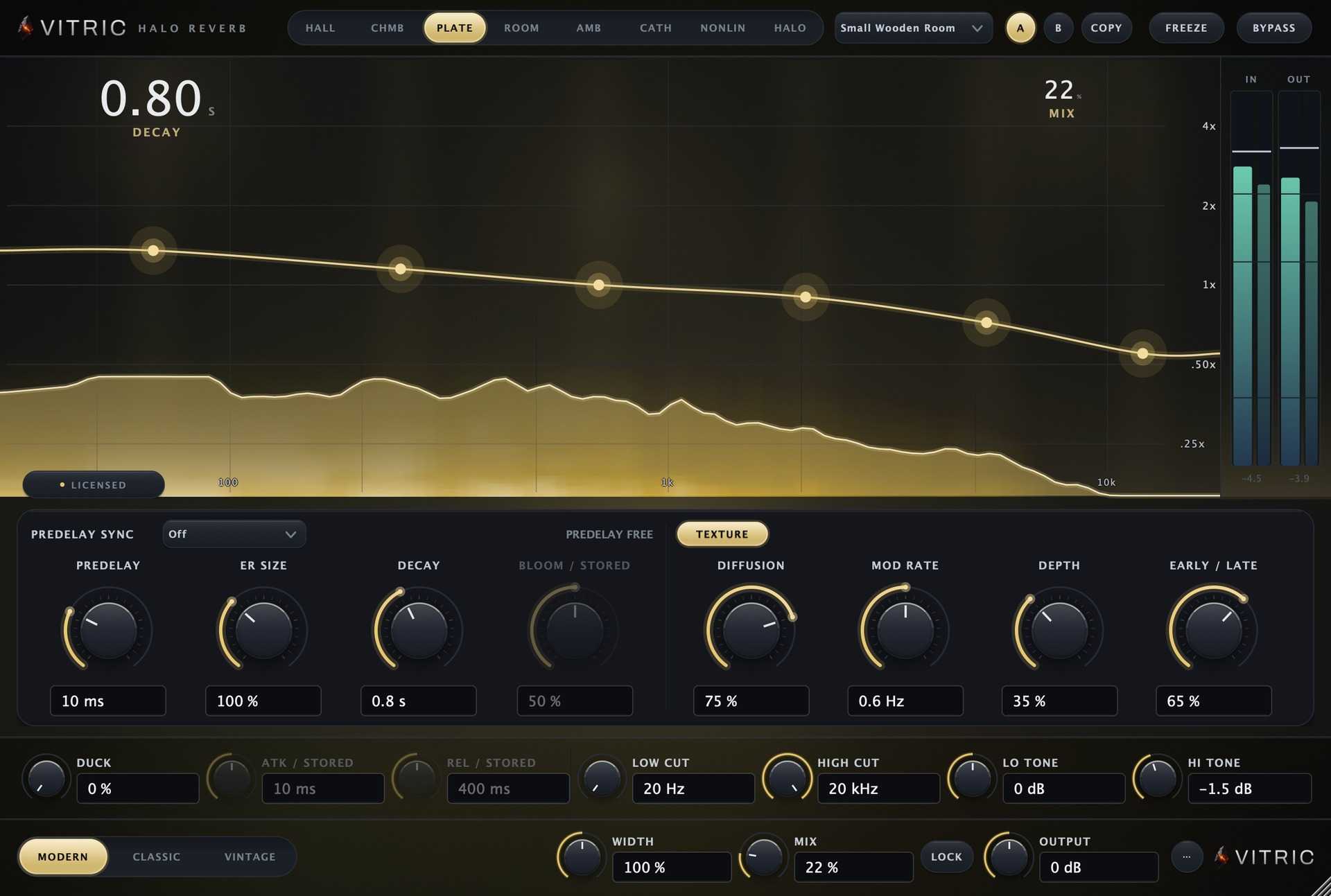
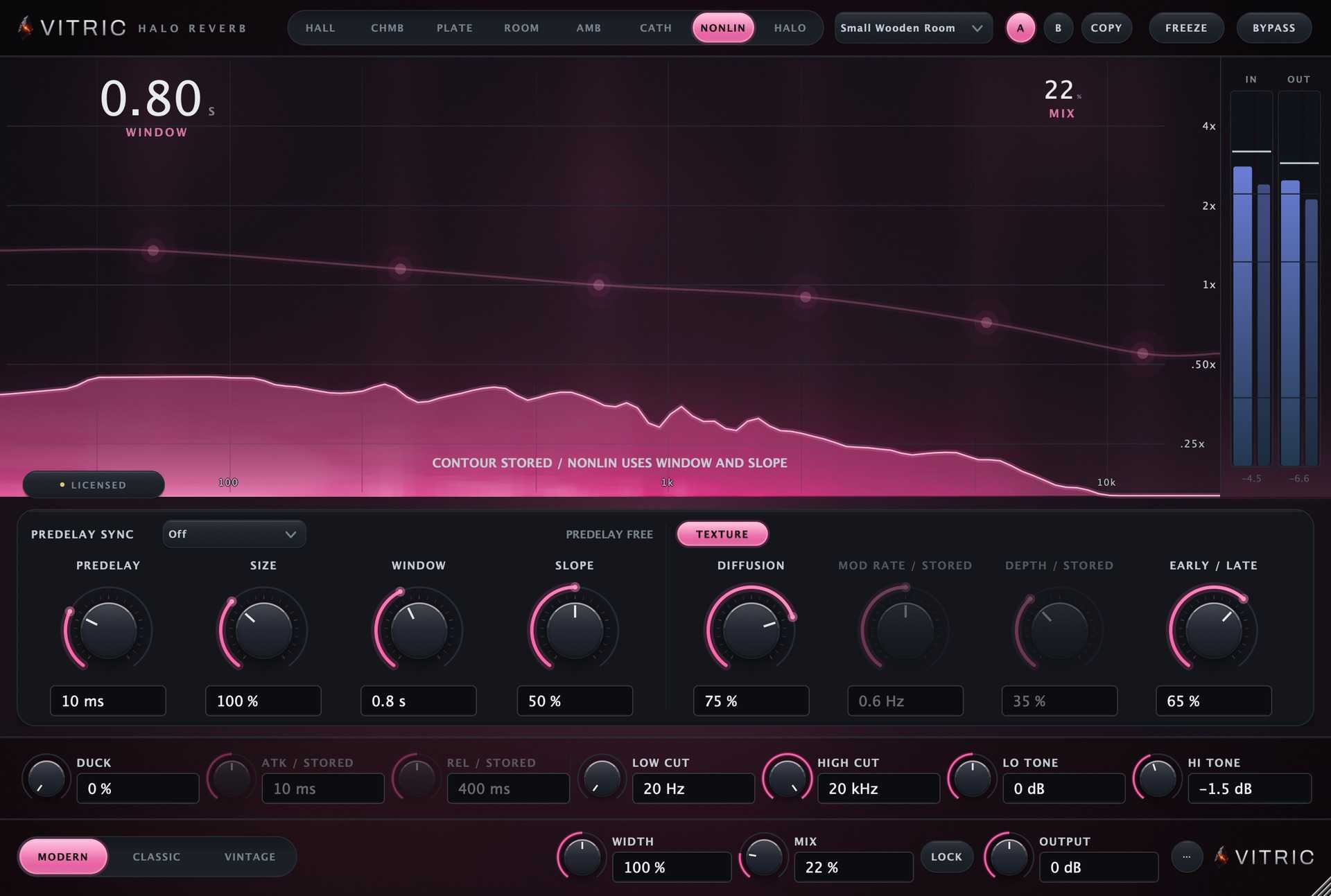
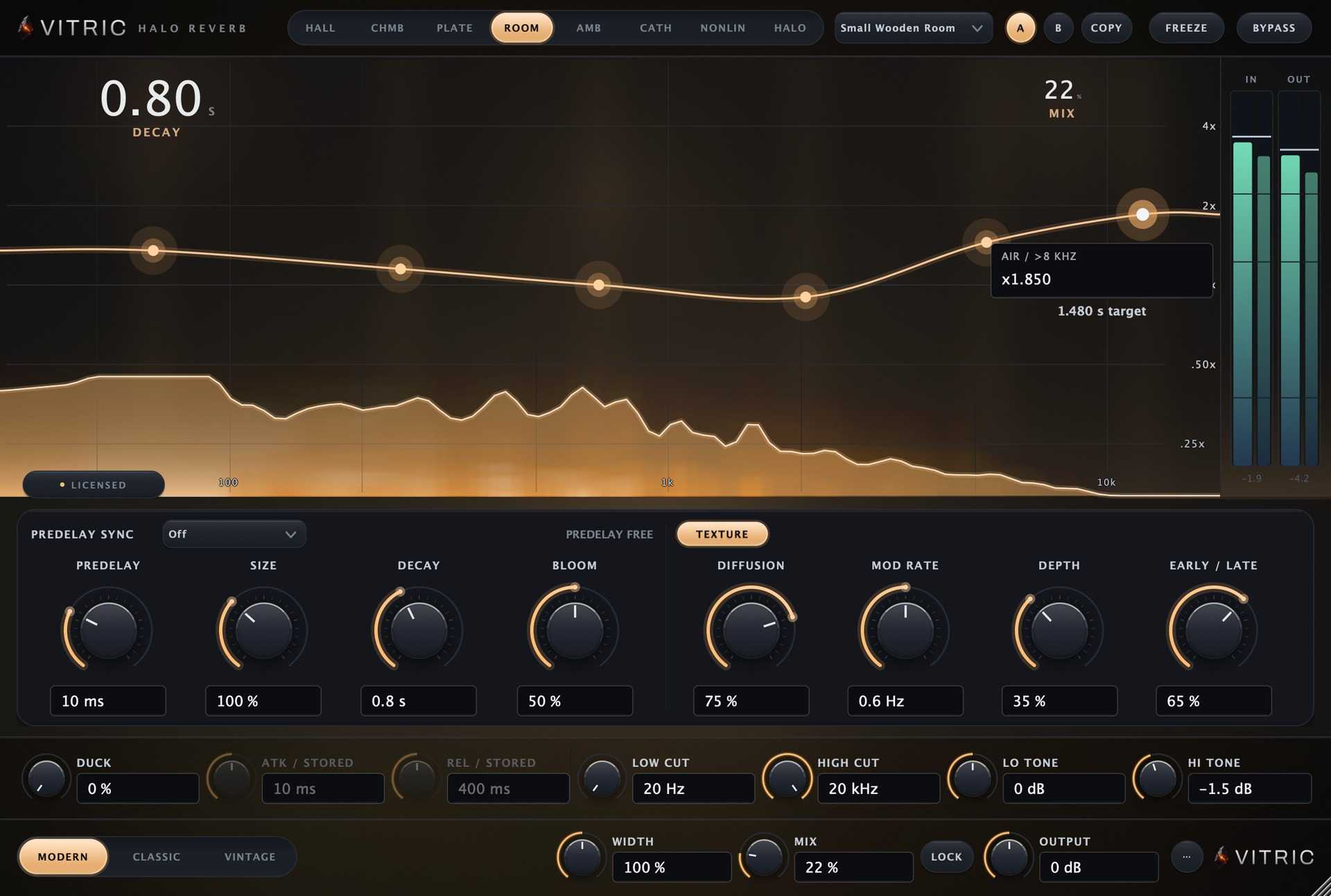
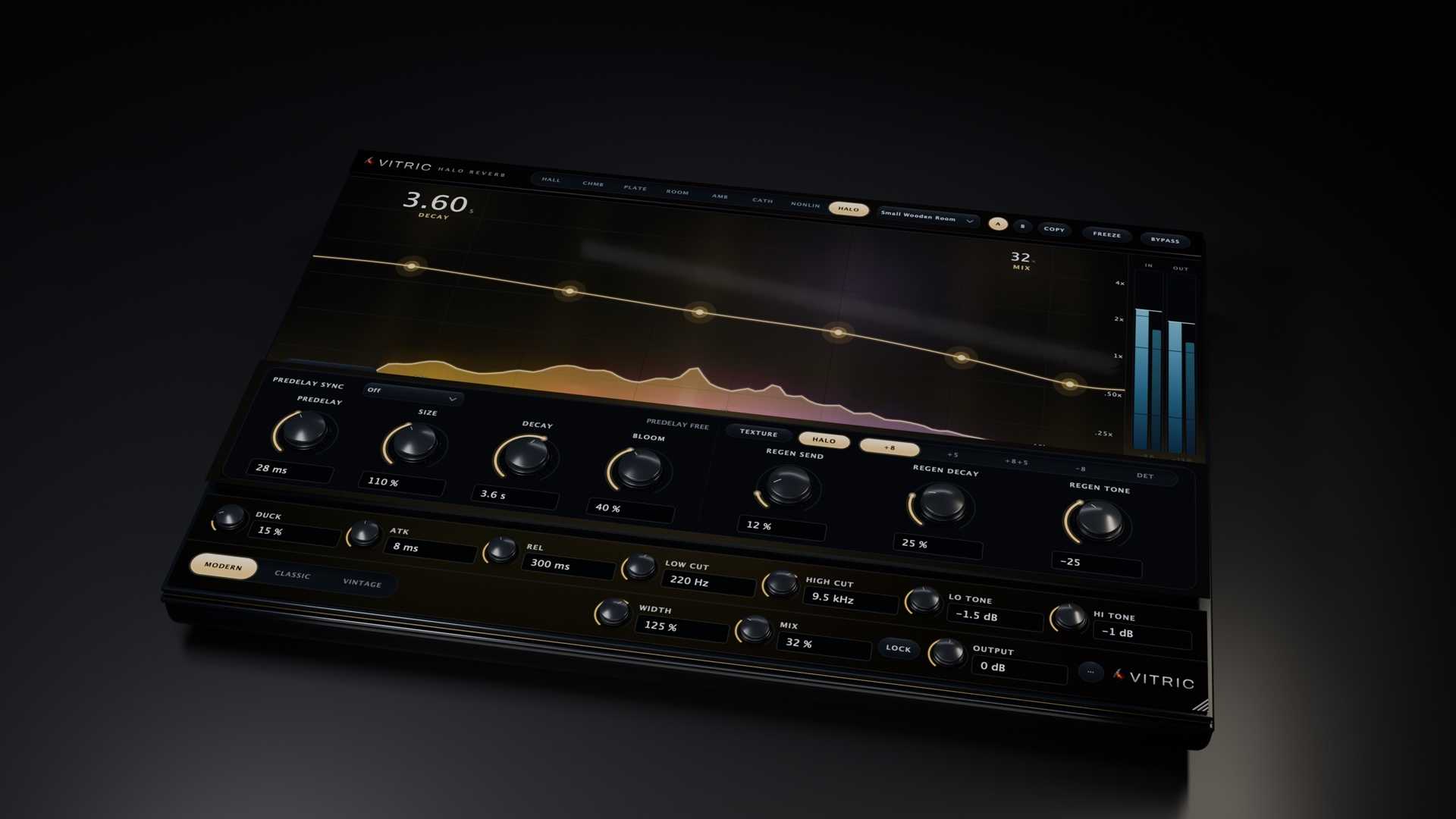
Hall, Chamber, Plate, Room, Ambience, Cathedral, Nonlin and HALO are eight separate engines, not presets of one algorithm. The rooms and halls run an eight-line modulated feedback delay network; Plate is a figure-eight plate topology that uses SIZE for its early reflections and ignores BLOOM; Nonlin is a 32-tap-per-channel gated engine with no feedback loop at all, where BLOOM becomes SLOPE and walks from reverse through gated to decaying; and HALO adds a granular pitch shifter inside the regeneration loop, with octave up, fifth up, octave plus fifth, octave down or detune, each pass climbing further. Switch spaces and the whole machine re-lights in that space's colour. The decay contour is the signature. Six bands, split at 150, 400, 1200, 3500 and 8000 Hz, each scaling the master decay from 0.25x to 4x, drawn as a curve of light over the live tail with every node grabbable. Select a node and it names its own frequency band, shows its exact ratio and derives the target time in seconds; type the ratio you want and it commits on Return. The filters doing the work are absorptive filters inside the feedback loop, so the measured reverb time really follows the curve you drew: RT60 tracks the display within 10 percent at 0.5, 2, 8 and 20 second settings. Master decay runs from 0.1 to 60 seconds. Around that: predelay 0 to 500 ms, free or synced to the host from 1/32 to 1/4 with dotted and triplet values, falling back to the manual value and saying so when the host has no usable tempo. Freeze holds an existing tail in the feedback spaces, click-free in and out, with tone, width, ducking and mix all still live while it hangs. Ducking has amount, attack and release, driven by the dry signal. Three eras voice the whole machine: MODERN is full bandwidth, CLASSIC caps at 15 kHz with noisier modulation, VINTAGE caps at 10 kHz, darker still. Wet-path low and high cut, low and high tone shelves, width from 0 to 200 percent that stays mono-compatible, a mix lock for browsing presets, A/B with copy, and output trim. 43 factory presets plus Default, in six banks. Zero samples of latency and no lookahead anywhere. The window resizes from 900x620 to 1650x1110 at a fixed aspect. The six contour bands sit at fixed splits rather than freely placed nodes, and Nonlin stores those ratios without applying them, because it is a finite window with no feedback to shape. Halo Reverb is stereo, taking mono or stereo in and stereo out, with no surround format. Built and used at a working recording studio.
Not enough reviews yet